


The Self Does Not Tremor
- Cecelia Ky-Lan Do
- Dec 5, 2025
- 12 min read

by John Pierre Alkhoury
art by Noelle Biehle

How do you define your identity? As a college student, you may still be exploring what that exactly means to you. Is it the sum of all your lived experiences? Is it a series of beliefs you apply to everything you encounter? Is it something physical? Or you may be asking, how does identity shape your purpose? These philosophical questions have undoubtedly crept into your life at one point or another. However, they become more complicated when you consider them in the context of a condition that repeatedly challenges who you are.
The Neuropathology and Philosophy of PD The condition in question is Parkinson’s Disease (PD). To answer these questions, we can explore the scientific background of PD and how it illuminates complementary philosophical schools of thought. For example, how can we define PD beyond its parallels with nihilism’s loss of meaning? How can the brain’s neuroplasticity, or its ability to strengthen certain neural networks and processes, go hand in hand with idealism’s empowerment of perception? Most importantly, how can we understand PD as a personal condition that varies from individual to individual and shapes one’s life-long identity?
Understanding what PD is begins with understanding α-synuclein's role in its onset. α-synuclein is a protein abundant in presynaptic terminals that coordinates neuronal communication through neurotransmitter release and regulates cell movement [1]. PD develops when α-synuclein misfolds and aggregates into “clumps” of itself. These clumps are known as Lewy Bodies and contribute to cell death around the neuron, largely impairing cell communication. These α-synuclein aggregates can also be found in the axons or dendrites, in which case they are named Lewy neurites. Collectively, these protein abnormalities disrupt neural communication throughout the brain, giving rise to the characteristic symptoms of PD [2].
Parkinson’s can be characterized by two groups of symptoms: motor and non-motor. Mostly external, Motor symptoms may include impaired balance, bradykinesia (slowness of movement), or, most commonly, tremors. On the other hand, non-motor symptoms consist of apathy (loss of emotion), depression, and changes in agency [3]. These symptoms, particularly those that are non-motor, now bring up the question of the subjective experience of PD: how does it influence identity or purpose? Can this lost agency be restored?
For most of history, philosophy has been largely concerned with exactly these questions. You may have philosophized yourself about purpose, which is commonly encapsulated in the question “What is the meaning of life?” To get the most out of this question’s importance to PD, let us first set a clear definition for what purpose is. Of course, one’s meaning or purpose is subjective. But it is possible to get closer to a satisfactory definition when you consider what kind of people are most likely to develop PD: those in late adulthood (typically age 65+) [4]. Psychologist Erik Erikson can aid us through his definition of that chronological stage in life through the decision of “Integrity vs. Despair,” at which an individual is likely to be questioning the utility of their life: was their life “lived well” and with integrity [5]? Integrity is rooted in the idea that one “stayed true to themselves,” a definition that requires a strong sense of identity in order to be fulfilled. One would expect their identity to be comprised of their lived experiences at that stage in life.
Dementia, Identity, and Nihilism
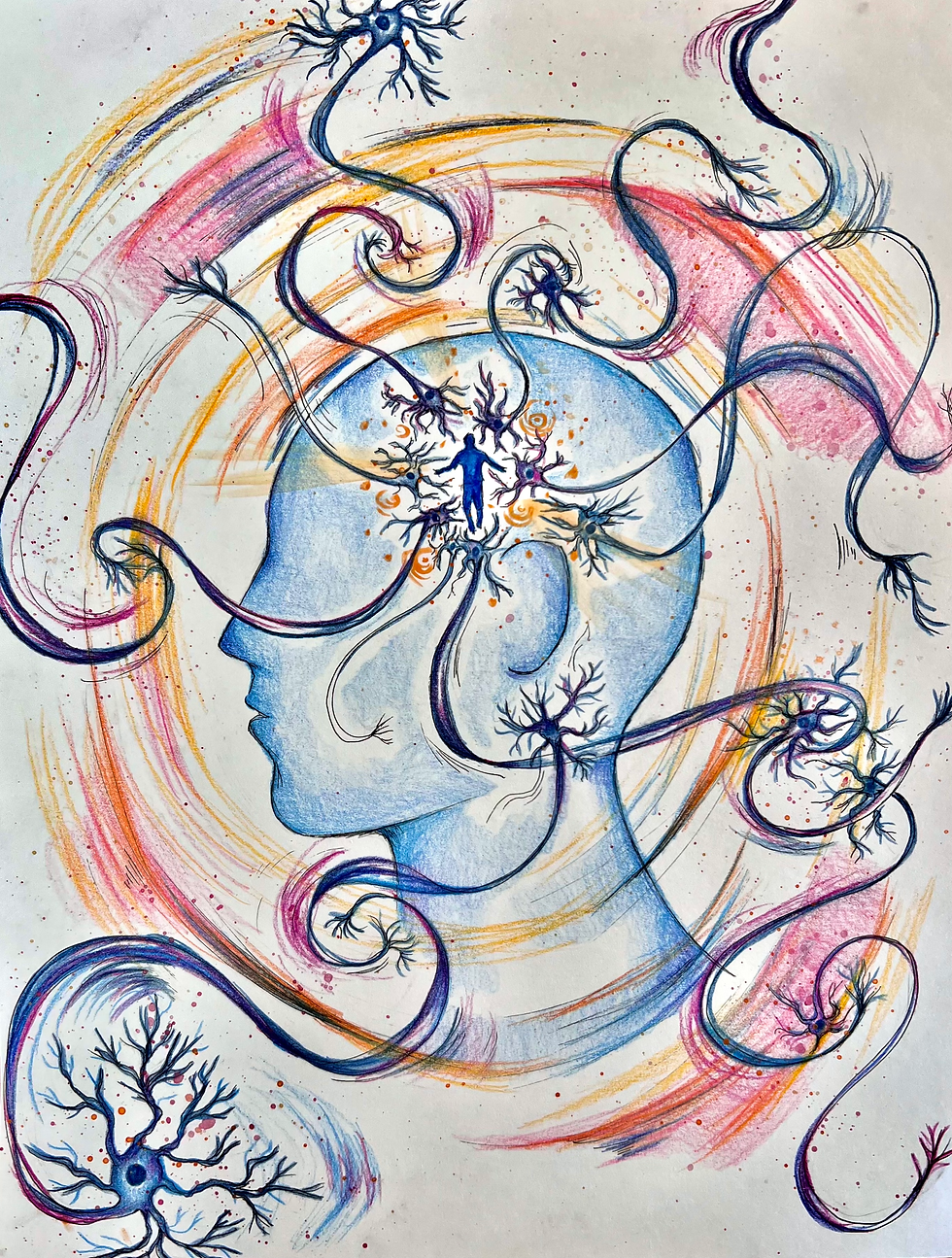
But what happens when dementia, a common symptom of PD, compromises these lived experiences from the perspective of people with Parkinson’s (PwP)? For most, dementia may evoke fear and a sense of erasure. The possible onset of dementia in PwP impairs memory, becoming more severe with the progression of PD [6]. In PD, Lewy body aggregation typically begins in the lower brainstem, a part of the lower brain connected to the spinal cord that governs many automatic, life-sustaining functions (breathing, heart rate, digestion, etc.) [7]. It eventually progresses to the cerebral cortex, a layer of the cerebrum that plays an important part in consciousness. More specifically, Lewy bodies aggregate within the frontal and temporal lobes within the cerebral cortex; these lobes govern executive functions (planning, decision-making, social traits) and memory formation, leading to the onset of dementia [8].
The erasure of memory may entail the erasure of identity for an individual in which case we turn to nihilism and how it pertains to PD. Nihilism postulates that nothing has inherent meaning, value, or truth, requiring a forfeiture of agency [9]. Using this definition, consider how a nihilist would approach PD: having lost their memory, PwD may not know anything for certain. How, then, can they substantiate life itself?
Such an existence seems to affirm nihilism’s assertions. This is only exacerbated as the relationships with PwD’s loved ones that were built on memories become severed. As executive function and memory decline, PwD lose any point of reference for their identity. They find themselves stuck in a cycle of reconstructing their fragmented identity through others, in vain. If identity is built on experience and a sense of continuity, dementia renders both obsolete, extending nihilism’s meaninglessness to encompass identity itself.
The deformation of identity is not strictly determined by memory impairment, but is also governed by reduced motivation to act. This involves another characteristic symptom of PD: the degradation of dopaminergic neurons in certain brain regions, beginning in the substantia nigra, a brain structure essential to dopamine production and motor control [3]. Dopaminergic neurons produce dopamine, a neurotransmitter that ultimately regulates decision-making and influences reward perception. This dopamine loss affects pathways in the ventral tegmental area: two being the mesocortical and mesolimbic pathways [10]. The mesocortical pathway projects to the prefrontal cortex, governing attention, decision-making, and working memory [11]. The mesolimbic pathway projects to the amygdala, hippocampus, and related structures, forming the brain's reward system by reinforcing learning and regulating behavior [12]. This dopaminergic loss leads us to a troubling revelation: an implied loss of hope seems to align closely with what nihilism postulates. How can PwP preserve meaning and identity despite this?
Legacy as a Rebuttal to Nihilism
Nihilism does not, in and of itself, define the experiences (subjective or objective) of PwP. To better understand this, we must consider how we evaluate legacy. Legacy is the culmination of an individual’s experiences based on the perspective(s) of their environment [13]. Alternatively, it could be defined as the identity of an individual from the perspective of others. Assuming that one’s environment must consist of those with whom they surround themselves, it can be argued that, so long as even one perspective is preserved, one’s legacy persists.
Looking beyond a philosophical narrative and at the neuropathology, the postulates of nihilism seem to assume the most extreme case of PD: one in which dementia completely wipes memory and, by extension, identity. However, is that what really happens? There is hope to be found in the idea that dementia fails to completely erase memory. Research on PD and preservation of meaning reveals that PwP rank certain, personal domains (like religion, family, relationships) as highly important to their lives, even during the more severe stages of PD. However, their satisfaction with their capacity for any given domain is diminished [14]. The satisfaction score contrasts with the importance rating in such a way that suggests that cognitive decline does not guarantee a loss of identity. Although PwP may acknowledge a certain level of inability to act upon their ideas and beliefs (as indicated by the diminished satisfaction score), the beliefs and values themselves remain steadfast, indicating that identity is never truly lost.

Idealism's Persistence Though Impaired Cognition
Essentially, PD could be considered highly restrictive across the sensory, motor, and cognitive domains of the body [15]. While motor symptoms are almost fully objective in the sense that they encompass actions we can see and know to be true, cognition poses the obstacle of subjectivity. Cognition is how one processes the world around them. It’s what leaves each individual’s unique trace on the world around them. Even if we can understand what happens in the brain, we are still left with the question of the individual. How can an impairment of thinking not compromise agency?
It should be clear that cognitive decline in PwP is not uniform and further supports the individualized experience of PD. In a recent study, researchers found that some individuals experienced progressive decline, but others remained relatively stable or experienced a lower rate of decline [16]. This study then posed a question: Can we pinpoint any determinants of cognitive decline? Factors such as baseline cognitive health could determine the severity of progression (those who already have cognitive impairments may be more susceptible to decline). Another determinant could be underlying neurodegeneration (deterioration of brain tissue), or simply certain demographics like age and educational history. Interestingly, this study also reinforces an existing distinction: postural instability and gait difficulty (PIGD) vs. tremor-dominant PD. Individuals with tremor-dominant PD were less likely to experience progressive decline in cognitive function as compared to those with PD of the PIGD classification [16]. This may be caused by PIGD PD involving more widespread neurodegeneration affecting memory and executive function regions (frontal, temporal, parietal lobes), whereas tremor-dominant PD remains largely restricted to the nigrostriatal dopaminergic system [17].
However, this cognitive decline does not necessarily entail complete dysfunction. One’s cognition is much more than their ability to understand or sense things. It also draws on one’s ability to perceive, to imagine, and to make things their own. It then follows that, rather than the material manifestation of PD–tremoring limbs, dying neurons, we should shift to the immateriality of the mind. Idealism equips us with a way to reconcile PD’s material imposition through its claim that reality is entirely shaped by the mind, or cognition; the objects we can touch are inseparable from the way we perceive them. In lieu of this, idealism can offer a perspective on how PwP can still leave their mark on the world.
A Contradiction Between PD and Nihilism: the Limits of Idealist Agency
Here, there is a contradiction between the science and a philosophical outlook: A recent study found that PD can cause visual and auditory hallucinations. These hallucinatory experiences are rooted in neurotransmitter dynamics. In no particular order, dopamine can be dysregulated, leading to abnormal signalling to the basal ganglia and the visual cortex [18]. Simultaneously, loss of cholinergic neurons (nerve cells that carry the acetylcholine neurotransmitter and are essential to attention) leads to reduced activity in perception. Serotonin, which is also a neurotransmitter plummets, causing reduced visual processing ability [18].
The contradiction lies in the idea that hallucinations are not voluntary conceptions of the individual, which opposes idealism’s emphasis on the voluntary structuring of the world based on one’s perception. However, another way to examine this relationship would be to identify that the hallucinations and the core ideas of idealism are not necessarily at odds with one another. The individual is still responsible for creating their own experiential reality, but the exact sovereignty with which they do so is somewhat compromised and not on par with idealism. Furthermore, examining the experience of dreaming bridges these two together and clears the tension between them. In an attempt to explain dreams, which resemble hallucinations, idealism postulates that they are the mind’s way of structuring experience in the absence of external stimuli. Following that, hallucinations in PwP still align with the idealist definition, considering that PwP experience less external stimulation with the progression of the disease, leading to possible overcompensation in the form of dreams slipping into a wakeful state [15].
Dismissing Parkinson’s as a product of the mind is ignorant and certainly unsatisfying. However, idealism is not intended to explain the cause of Parkinson’s as it is framed here, but rather to empower the capabilities of PwP rather than their restrictions. Idealism grants PwP agency; this agency is promised by the idea that the world is dependent on how we perceive it. Following that, any material restrictions are accounted for by the unrelenting capacity to perceive, a trait characteristic of any human being. Perception becomes cognition, and cognition becomes an exertion of control on our surroundings.
We have already discussed the perseverance of identity in the face of PD, but can PD also create identity that serves to empower and not paralyze? Junoso Sonja, a fashion model with Parkinson’s, is inclined to agree. In Balenciaga’s 2025 Haute Couture Fall show, she strutted down the runway, her eyes poised and head elevated as she permitted her elegant garments to trail her. The audience could see the tremors in her head, a symbolic encapsulation of a condition meant to divert her from her ambitions that was now imbuing every step with dignity and power [19].

Existentialism's Answer to PD
Human identity, alongside the brain’s neuroplasticity, seems to agree with idealism. Essentially, our brain’s circuits/connections can be strengthened, rewired, and expanded depending on lived experiences [20]. In the case of PD, neuroplasticity’s applications in PD treatment are a primary area of research. There have been advances in the field to stimulate plasticity in the brains of PwP. Scientists used theta-burst transcranial magnetic sStimulation (TMS) –a technique in which the brain receives small bursts of electricity via a magnetic coil– alongside transcranial alternating current stimulation (tACS) to deliver a certain frequency to the brain, one that mimics a brain pattern linked to memory and learning. The study found that brain cortices could be excited into a plastic state, marking a sign of hope for the future of PD research despite the severe neurodegeneration [21].
Having now discussed several facets of PD as a condition, as well as the merits/drawbacks of two distinct philosophical schools of thought, there are several possibilities for consolidating the two fields into an idea that pervades through the academic and clinical nature of PD. Above all, I have argued that identity transcends Parkinson’s disorders. Endless research can be done on the neuropathology, motor symptoms, and manifestation of the condition, but no amount of reproducibility begins to illuminate the unique experiences of every individual living with PD. Existentialism, the final philosophy I discuss, focuses on an individual’s search for the purpose of existence within an inherently meaningless world. It is a call to create one’s own distinct purpose as they see fit, independent of all that has happened or will ever happen. It is an assertion that purpose is not something that must be sustained; it is reforged in every living moment as humankind navigates its way through the absurdity of life. As Sartre claims in Existentialism is a Humanism, “Existence precedes essence.” An individual is not reducible to any of their traits or conditions; an individual’s identity is instead constituted by an intentional, continued desire to live [22]. With every passing moment, Parkinson’s patients do not submit to their condition; they choose to live despite it. They choose to love, to move, and to think.
REFERENCES:
Stocchi, F., Bravi, D., Emmi, A., & Antonini, A. (2024). Parkinson disease therapy: current strategies and future research priorities. Nature Reviews Neurology, 20(12), 695–707. https://doi.org/10.1038/s41582-024-01034-x
Calabresi, P., Mechelli, A., Natale, G., Volpicelli-Daley, L., Di Lazzaro, G., & Ghiglieri, V. (2023). Alpha-synuclein in Parkinson’s disease and other synucleinopathies: from overt neurodegeneration back to early synaptic dysfunction. Cell Death & Disease, 14(3), 176. https://doi.org/10.1038/s41419-023-05672-9
Kalia, L. V., & Lang, A. E. (2015). Parkinson’s disease. The Lancet, 386(9996), 896–912. https://doi.org/10.1016/S0140-6736(14)61393-3
Li, X., Zuo, X., Jing, J., Ma, Y., Wang, J., Liu, D., … Deng, H. (2015). Small-Molecule-Driven Direct Reprogramming of Mouse Fibroblasts into Functional Neurons. Cell Stem Cell, 17(2), 195–203. https://doi.org/10.1016/j.stem.2015.06.003
Orenstein, G. A., & Lewis, L. (2025). Erikson’s Stages of Psychosocial Development. In StatPearls. Treasure Island (FL): StatPearls Publishing. Retrieved from http://www.ncbi.nlm.nih.gov/books/NBK556096/
Gallagher, J., Gochanour, C., Caspell-Garcia, C., Dobkin, R. D., Aarsland, D., Alcalay, R. N., … for the Parkinson’s Progression Markers Initiative. (2024). Long-Term Dementia Risk in Parkinson Disease. Neurology, 103(5), e209699. https://doi.org/10.1212/WNL.0000000000209699
Borghammer, P., Okkels, N., & Weintraub, D. (2024). Parkinson’s Disease and Dementia with Lewy Bodies: One and the Same. Journal of Parkinson’s Disease, 14(3), 383–397. https://doi.org/10.3233/JPD-240002
Aarsland, D., Batzu, L., Halliday, G. M., Geurtsen, G. J., Ballard, C., Ray Chaudhuri, K., & Weintraub, D. (2021). Parkinson disease-associated cognitive impairment. Nature Reviews Disease Primers, 7(1), 47. https://doi.org/10.1038/s41572-021-00280-3
Nihilism | Definition & History | Britannica. (n.d.). Retrieved 18 November 2025, from https://www.britannica.com/topic/nihilism
Elum, J. E., Szelenyi, E. R., Juarez, B., Murry, A. D., Loginov, G., Zamorano, C. A., … Zweifel, L. S. (2024). Distinct dynamics and intrinsic properties in ventral tegmental area populations mediate reward association and motivation. Cell Reports, 43(9). https://doi.org/10.1016/j.celrep.2024.114668
Mesocortical Pathway - an overview | ScienceDirect Topics. (n.d.). Retrieved 4 November 2025, from https://www.sciencedirect.com/topics/neuroscience/mesocortical-pathway
Mesolimbic Pathway - an overview | ScienceDirect Topics. (n.d.). Retrieved 4 November 2025, from https://www.sciencedirect.com/topics/neuroscience/mesolimbic-pathway
Ben-Porath, N. (n.d.). Eudaimonia and Kleos: An Analysis of Legacy’s Contribution to Well-Being. Retrieved from https://pressbooks.lib.vt.edu/pper/chapter/volume-1/
Bublitz, S. K., Brandstötter, C., Fegg, M., Ferreira, J. J., Odin, P., Bloem, B. R., … Lorenzl, S. (2024). Meaning in Life in Late-Stage Parkinson’s Disease: Results from the Care of Late-Stage Parkinsonism Study (CLaSP) in Six European Countries. Journal of Religion and Health, 63(3), 2140–2154. https://doi.org/10.1007/s10943-023-01962-w
Lungu, R., Fernandes, F. F., Pires Monteiro, S., Outeiro, T. F., & Shemesh, N. (2025). Neural and vascular contributions to sensory impairments in a human alpha-synuclein transgenic mouse model of Parkinson’s disease. Journal of Cerebral Blood Flow & Metabolism, 0271678X251338952. https://doi.org/10.1177/0271678X251338952
Kawabata, K., Djamshidian, A., Bagarinao, E., Weintraub, D., Seppi, K., & Poewe, W. (2024). Cognitive dysfunction in de novo Parkinson disease: Remitting vs. progressive cognitive impairment. Parkinsonism & Related Disorders, 120, 105984. https://doi.org/10.1016/j.parkreldis.2023.105984
Rosenberg-Katz, K., Herman, T., Jacob, Y., Kliper, E., Giladi, N., & Hausdorff, J. M. (2016). Subcortical Volumes Differ in Parkinson’s Disease Motor Subtypes: New Insights into the Pathophysiology of Disparate Symptoms. Frontiers in Human Neuroscience, 10. https://doi.org/10.3389/fnhum.2016.00356
Eversfield, C. L., & Orton, L. D. (2019). Auditory and visual hallucination prevalence in Parkinson’s disease and dementia with Lewy bodies: a systematic review and meta-analysis. Psychological Medicine, 49(14), 2342–2353. https://doi.org/10.1017/S0033291718003161
331K views · 4.2K reactions | #balenciaga couture fall 2025 featured a model living with Parkinson’s disease walking the runway at its Fall/Winter 2025 fashion show. This show also marks #Demna’s final work as Balenciaga’s creative director. Unfortunately we could not identify the model. #fyp #fashion #styleblogger #fashionweek #fashionblogger #fashiondesigner #beautiful #follow #fashionblog #fashionmodel #fashionista #Runway #catwalk #collection #fashionblog #blog #fashionaddict #fashionstyle #ootd #pfw #couture #parisfashionweek | Style Revolver. (n.d.). Retrieved from https://www.facebook.com/reel/1392128972075384/
Marzola, P., Melzer, T., Pavesi, E., Gil-Mohapel, J., & Brocardo, P. S. (2023). Exploring the Role of Neuroplasticity in Development, Aging, and Neurodegeneration. Brain Sciences, 13(12), 1610. https://doi.org/10.3390/brainsci13121610
Tan, J., Rurak, B. K., Helmich, R. C., Rodrigues, J. P., Power, B. D., Drummond, P., … Vallence, A.-M. (2025). Combined TMS and transcranial alternating current stimulation induced neuroplasticity in tremor-dominant Parkinson’s disease. Clinical Neurophysiology, 2110776. https://doi.org/10.1016/j.clinph.2025.2110776
Sartre, J.-P. (1956). Existensialism is a Humanism. World Publishing Company. Retrieved from https://esp.mit.edu/download/1d2e51ba-1e3a-4924-b5b7-6b10fa991b51/H8732_Existentialism%20Reading%20-%20Splash.pdf


Comments