


I See Disney Cartoons
- Cecelia Ky-Lan Do
- Dec 5, 2025
- 12 min read

by Nick Thomas
art by Qingyang Meng
“Art thou not fatal vision, sensible / To feeling as to sight? or art thou but / A dagger of the mind, a false creation, / Proceeding from the heat oppressed brain?”
- Shakespeare, Macbeth, Act 2, Scene 1

In the early 1990s, patient Nancy S. visited neuroscientist Dr. V.S. Ramachandran regarding her unusual visual issues. As Dr. Ramachandran sat opposite of her, he gradually began to enter her left visual field. As he did so, he was slowly blocked by something strange in her field of vision.
“What do you see?” asked Dr. Ramachandran.
“Cartoons,” she replied.
“What?”
“Cartoons.”
“What do you mean by cartoons?”
“On some occasions I see Disney cartoons. But most commonly not. Mostly, what I see is just people and animals and objects. But these are always line drawings, filled in with uniform color like comic books” [2].
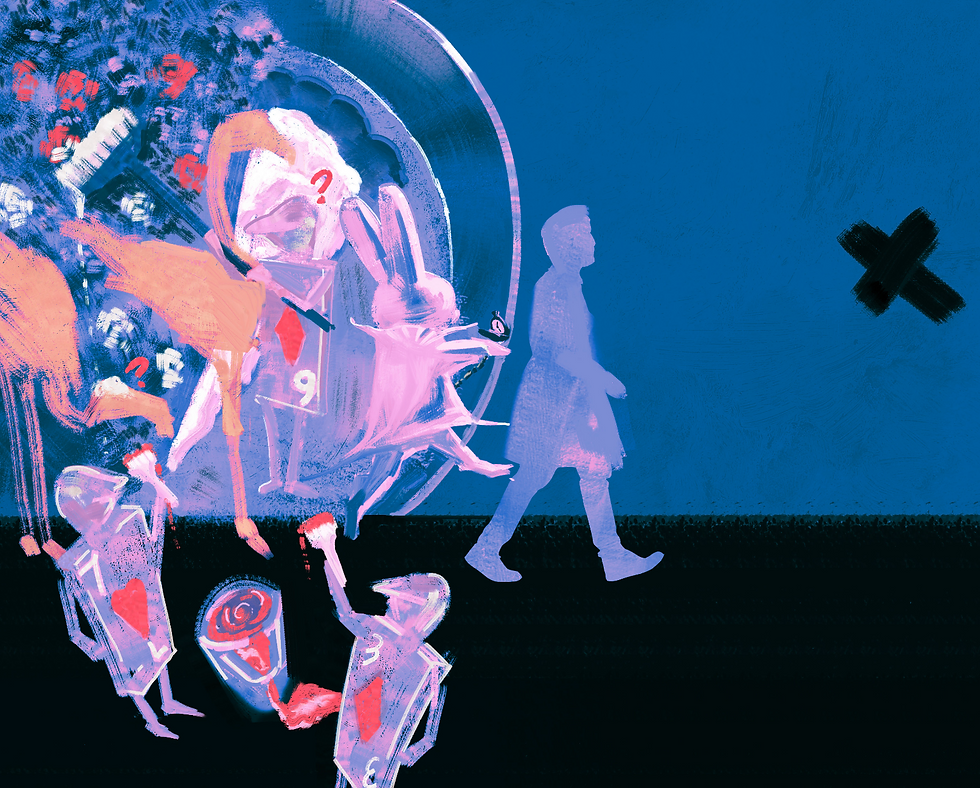
Dr. Ramachandran’s office was not actually suddenly flooded with cartoon characters, but was gradually warped in Nancy’s perception due to a large scotoma - a blind spot - in her visual field. As a result of an arteriovenous malformation (AVM) — a cluster of fused arteries and veins in the back of her brain — Nancy was left with scar tissue on parts of her visual cortex, resulting in this blind spot [2]. In later years, as Dr. Ramachandran explains, “this scotoma did not remain a blank lapse in Nancy’s vision, but filled up with cartoon characters.” Nancy describes these characters interacting with the real world, sitting in chairs or attempting conversation with real people. “I never know what’s coming next,” she explains [2], describing the unpredictability and near-daily appearance of the imagined figures.
Charles Bonnet Syndrome What Nancy describes here (and was later diagnosed with) is Charles Bonnet Syndrome (CBS). Characterized by visual hallucinations, CBS typically affects individuals with complete or partial vision loss. More specifically, those with CBS often report seeing people, faces, animals, natural scenes, and—in Nancy’s case—imagined figures [2].
What specifically sets CBS apart from other conditions involving visual hallucinations is the difference in self-awareness. While individuals with psychotic disorders (such as schizophrenia) are not typically aware that their hallucinations are false, those with CBS are usually able to distinguish between their internal and external stimuli. This is explained by the fact that CBS stems from visual impairment,whereas psychosis deals with dysfunctions in dopamine behavior and cortisol release [3]. However, for this reason, it leads these individuals to consider that their hallucinations are indicative of some ‘psychiatric illness’ [4]. Hence, people with CBS are usually far less likely to discuss their hallucinations for fear of being stigmatized. In fact, it is estimated that only 9% of people experiencing CBS seek medical advice. Of that 9%, only half of them receive an explanation of the syndrome [3]. Likewise, because those with CBS so rarely seek help, it is very difficult to accurately estimate the prevalence of the syndrome. Estimates also vary widely: some studies report rates between 6.7% and 8.1% of the global population [5], while others place it as high as 30% [3]. These results vary at this wide of a range due to a lack of self-reporting of CBS - likely meaning the number of those with the syndrome far exceeds current confirmed diagnoses. Most research, however, agrees that the onset of CBS is linked to vision loss and estimates that about 26% of all individuals with vision loss experience CBS at some point [6]. Although prevalence estimates range widely across studies, most fundamentally agree that CBS is underdiagnosed.
Due to the stigmas surrounding the onset of hallucinations, CBS can additionally produce a psychological weight to the individual experiencing it. Long-term studies have shown that visual hallucinations lead to problems with sleep, diet, education, and work [7]. Furthermore, nearly one-quarter of CBS patients report feeling anxious in response to their hallucinations, and a significant portion of patients report being perturbed by hallucinations. Further studies have also linked CBS with the onset of numerous ‘negative effects’, such as feelings of loneliness [8]. This often arises not only from the distress caused by hallucinations, but also from the general lack of awareness of CBS. In a cross-sectional survey of 499 physicians, 55% reported never being aware of CBS, and 85% had never discussed the possibility of it with low-vision patients [7].
While there is no current established cure for CBS, intervention is encouraged for those experiencing symptoms. Research has shown that simply being aware of CBS and its implications at the time of onset offers “psychological protection” and is predicted to reduce negative psychological outcomes by about 20% [7]. With this in mind, psychologists have created various frameworks to both identify and respond to CBS—focusing particularly on person-centered therapy, psycho-education, and personal support for those experiencing CBS. This being said, the societal stigmas surrounding CBS create a major hurdle that prevents such individuals from proper interventions; thus feeding into the underrepresentation and underresearch of the syndrome.
Seeing Without Input
Despite being under-researched, what do scientists currently know about the unique neurobiology behind CBS? Surprisingly, they are related to a phenomenon we all encounter. In our eyes, we all have a blind spot where the visual nerve leaves the retina [9]. This area contains no photoreceptors — specialized cells in our eyes for visual information — creating a very small lapse in our vision. Using contextual information from the environment, the brain creates an educated guess about what is likely to exist in our blind spot. It “back-fills” our vision to create the illusion that the blind spot does not exist - which is also why we don’t notice a small black hole in our vision [6].
This “back-filling,” however, is fallible and can be tested using a ‘Blind Spot Test’ [10].

To do this, shut your right eye while looking at the image below. While focusing your left eye on the ‘x’ on the right, slowly move away from the page. At a certain distance (around 8-9 inches), the circle on the left should enter your blind spot and disappear completely. As your blind spot falls on the black dot against the white backdrop, your brain does not receive visual information about it and assumes that the black dot is not there. It then guesses it is most probable the white background continues on in this blind spot, which creates the resulting illusion of the black dot’s disappearance.
What Nancy and others with CBS experience is essentially the same phenomenon that fills in our blind spots - but on a much larger scale. For reference, our blind spot takes up about 2% of our visual field, which is why it usually goes unnoticed [11]. However, Nancy estimates her blind spot to be twice the size of her palm when her arm is fully extended before her. Her brain therefore has to back-fill far more information than ours does. This mirrors the experience that many have with scotomas - small blind spots caused by brain injury. In cases where these scotomas are large, the visual system must fill in far more missing information to create a complete image of reality [12]. Instead of merely filling in a small dot, the brains of those with these scotomas must make inferences about larger parts of the visual field, and thus larger objects. Was that object a cat? Or maybe a car? A person? With so much missing information to reconstruct, there’s a much greater margin for error, which is why patients with CBS usually see vivid hallucinations. In short, their hallucinations are an incorrect result of a brain trying to continually piece together a constantly changing, and incomplete, reality.
If this is true, why then would Nancy’s brain assume something fictional, like cartoon characters, would be the most likely fit for reality? Understanding this requires a new working definition of perception. In neuroscience, perception is generally considered a result of both bottom-up and top-down processing. When we use bottom-up processing, we mostly rely on external sensory inputs [13]. For example, if you are in a dark room and stretch out your arms to feel your surroundings, you perception is guided mostly by sensory feedback from your hands. Top-down processing, on the other hand, draws on ‘higher’ areas of the brain that use prior experience and goals to build a perception of reality. When you easily navigate your own house in the dark, you rely less on sensory stimuli and more on the stored knowledge of your environment [13]. In this case, your perception is driven by memory, allowing you to more confidently move about without as much sensory input.
Mapping the flow of visual information is also important to fully understand how our brain perceives the world. When light enters through the retinas of our eyes, it is converted into information that our brain can use by specialized photoreceptors. This information is then sent through the optic nerve and into the lateral geniculate nucleus of the thalamus — an area that acts as a relay station, sorting and organizing visual information — before it is sent to visual centers of the brain [14]. The information is then sent to the primary visual cortex (which processes basic visual features: edges, colors, motion) before finally being sent to one of two main pathways. If sent upward in the brain to the dorsal stream, the information travels toward the parietal lobe, a region involved in spatial awareness and guiding movements. In this stream of vision, the brain decides “where” the visual information is and “how” to interact with it. By contrast, going down to the ventral stream and toward the temporal lobe — a region associated with memory, object recognition, and identification — the brain decides “what” the information is. When we see an object, such as a dog, we use all forms of these visual systems. Using bottom-up processing, we look at the individual features of the dog (the shape of a four-legged animal, and the colors of its fur), while our top-down processing rakes through our memory of animals and considers our expectations (e.g. what dogs usually look like, and if we may be somewhere we are likely to see a dog, like a park). At the same time, our ventral stream similarly accesses our past memories of dogs. Our dorsal stream tells us just how far the dog is away from us, and how we might interact with the dog [14].
In this sense, CBS re-wires the way patients think and experience reality by altering their neural pathways. In fact, studies evaluating blood flow in the brain of those experiencing the visual hallucinations associated with CBS found an increased amount of blood flow to regions in the lateral temporal cortex, striatum, and thalamus - all correlated with some aspect of memory and recognition [3]. Because these regions experience a greater amount of blood flow, there is a corresponding increase in activation in the emotional and motivational centers of the brain. This fundamentally supports the idea that Nancy’s brain must ‘work harder’ by back-filling more information to construct her interpretation of reality. Furthermore, because lateral temporal cortices — regions associated with certain types of memory — of those with CBS show a greater activation here, it is likely that their brain is working harder to comb through their memories to form their sense of reality (i.e. the brain is hyperactive, given an increased flow of blood) [15]. Therefore, this rushed memory retrieval is likely what creates the rather ‘unrealistic’ hallucinations that Nancy faces: as her brain tries to make sense of reality, it combs through past experiences to understand it, through which it constantly retrieves a familiar source (cartoons).
This evidence has been supported by various SPECT (single-photron emission computed tomography) studies, which create a 3D map of the flow of blood through the brain [15]. These studies have shown that individuals with CBS display asymmetrical blood flow to their lateral temporal lobes - areas of the brain associated with memory - while they experience hallucinations. This blood flow likely reflects an “over-activation of the hemi-structures”, as noted by the authors. Suggesting that, when individuals with CBS hallucinate, their brains over-activate areas associated with memory; likely as a means to search through past experiences to make predictions about the world [15].

When we imagine a subject, neuroscientists have discovered that something interesting occurs: the brain’s visual processes actually begin to work in reverse [13]. For instance, if we were to imagine a dog, all of our memories of dogs flow from top to bottom– information moves from higher-level visual areas and into the primary visual cortex, creating an impression on the ‘mind’s eye’ without visual information. For this reason, Dr. Ramachandran likens the processing of visual information in the brain to a funhouse full of mirrors: “Like separate light beams in a funhouse, visual information can take many different paths, sometimes diverging, sometimes reinforcing itself, sometimes traveling in opposite directions,” [2].
So, why don’t we hallucinate every time we imagine a subject? Within this ‘funhouse’ of visual information in our brain, one thing is able to keep us grounded in reality: the information taken in by our eyes. Even when we close our eyes, photoreceptors are constantly taking in information, producing a non-stop baseline signal. This baseline signal informs our higher visual centers if there truly is an object hitting the retina [16]. In this sense, the information taken in by our photoreceptors supersedes the imagined images our brain creates. Even though our brain impresses an image of an imagined dog into our primary visual cortex, the information from our photoreceptors tells us, “Nope, no dog”.
When these photoreceptors can no longer send information correctly (such as in Nancy’s case), the brain cannot reaffirm if something imagined is actually in the visual field. However, higher cortical areas than the visual field can still make this distinction, allowing those with CBS to recognize that their hallucinations are not real.
Unfortunately, because CBS is so underrepresented in neurological research (over 60% of research on CBS has been done in the last 14 years) there does not yet exist any set, widely agreed upon model that explains its neuroscientific underpinnings [7]. But, we can still learn a great deal about our own neurobiology. Perhaps, those with CBS can tell us more about what exactly occurs in our own vision and the underpinnings of how our brains form our sense of reality.
The Eye's Reflection

In his final discussions about CBS, Dr. Ramachandran writes, “...perhaps we are hallucinating all the time and what we call perception is arrived at by simply determining which hallucination best conforms to the current sensory input…” [2]. In this regard, CBS may allude that our brain (just like Nancy’s) is constantly imagining hypothetical subjects,not just in our blind spots, but all over our visual field. Perhaps, in trying to make sense of reality, our brain may be constantly imaging and asking us, “Is that a clown? A dog? A cartoon character?”, to which the information from our photoreceptors and higher visual centers must clarify, “Nope, those aren’t actually there.” How then are we sure that these higher visual centers are making the right predictions? How do we know the bases they’re going off of to choose a “correct” reality for us to see? How are we ever sure that we are seeing a “correct” form of reality? To this rather philosophical question, the honest answer is that we don’t know - neuroscience is yet to find an answer to this, if one even exists.
If anything, CBS reminds us just how flexible our perception of reality is. For the same reason, it should not be as harshly stigmatized. CBS deserves understanding without being viewed as a fundamental flaw; it deserves awareness without judgment. CBS allows us to come to terms with the fragility of our own perception - inviting us to embrace the delicacy with which our brains craft reality, and provoking us to inquire more about the true form of it.
REFERENCES:
1. Shakespeare. (1992). Macbeth. In Macbeth (R. Greenblatt.). Penguin Classics.
2. Ramachandran, V. S. (1999). Phantoms in the Brain: Probing the Mysteries of the Human Mind. Mariner Books.
3. Pang, L. (2016). Hallucinations Experienced by Visually Impaired: Charles Bonnet Syndrome. Optometry and Vision Science, 93(12), 1466–1478. https://doi.org/10.1097/OPX.0000000000000959
4. Abdulhussein, D., Jones, L., Dintakurti, S. H., & Moosajee, M. (2024). Practice patterns in reporting and documentation of Charles Bonnet syndrome: a retrospective review following COVID-19. Therapeutic Advances in Ophthalmology, 16. https://doi.org/10.1177/25158414241232285
5. Maruzairi, H., & Joo, C. L. (2022). A Case Report on Charles Bonnet Syndrome. Iranian Journal of Psychiatry, 17(2), 240–242. https://doi.org/10.18502/ijps.v17i2.8914
6. Christoph, S. E. G., Boden, K. T., Pütz, A., Januschowski, K., Siegel, R., Seitz, B., … Schulz, A. (2024). Epidemiology and phenomenology of the Charles Bonnet syndrome in low-vision patients. International Ophthalmology, 44(1), 375. https://doi.org/10.1007/s10792-024-03298-0
7. Jones, L., Ditzel-Finn, L., Enoch, J., & Moosajee, M. (2021). An overview of psychological and social factors in Charles Bonnet syndrome. Therapeutic Advances in Ophthalmology, 13, 25158414211034715. https://doi.org/10.1177/25158414211034715
8. Higgins, B., Taylor, D., Crabb, D., & Callaghan, T. (2024). Emotional well-being in Charles Bonnet syndrome: exploring associations with negative affect, loneliness and quality of life. Therapeutic Advances in Ophthalmology, 16, 25158414241275444. https://doi.org/10.1177/25158414241275444
9. Michel, M., Gao, Y., Mazor, M., Kletenik, I., & Rahnev, D. (2024). When visual metacognition fails: widespread anosognosia for visual deficits. Trends in Cognitive Sciences, 28(12), 1066–1077. https://doi.org/10.1016/j.tics.2024.09.003
10. Experiment: Blind Spot. (2017, September 14). American Academy of Ophthalmology. Retrieved October 12, 2025, from https://www.aao.org/eye-health/anatomy/experiment-blind-spot
11. Meermeier, A., Lappe, M., Li, Y. H., Rifai, K., Wahl, S., & Rucci, M. (2023). Fine-scale measurement of the blind spot borders. Vision Research, 211, 108208. https://doi.org/10.1016/j.visres.2023.108208
12. Lin, Y.-S., Chen, C.-C., & Greenlee, M. W. (2022). Neural correlates of lateral modulation and perceptual filling-in in center-surround radial sinusoidal gratings: an fMRI study. Scientific Reports, 12(1), 16143. https://doi.org/10.1038/s41598-022-20592-y
13. Katsuki, F., & Constantinidis, C. (2013). Bottom-Up and Top-Down Attention: Different Processes and Overlapping Neural Systems. The Neuroscientist, 20(5). https://doi.org/10.1177/1073858413514136
14. Gupta, M., Ashley C. Ireland, & Bruno Bordoni. (2022). Neuroanatomy, Visual Pathway. National Library of Medicine. Retrieved from https://www.ncbi.nlm.nih.gov/books/NBK553189/
15. daSilva Morgan, K., Collerton, D., Firbank, M. J., Schumacher, J., ffytche, D. H., & Taylor, J.-P. (2025). Visual cortical activity in Charles Bonnet syndrome: testing the deafferentation hypothesis. Journal of Neurology, 272(3), 199. https://doi.org/10.1007/s00415-024-12741-2
16. Zmigrod, L., Garrison, J. R., Carr, J., & Simons, J. S. (2016). The neural mechanisms of hallucinations: A quantitative meta-analysis of neuroimaging studies. Neuroscience & Biobehavioral Reviews, 69, 113–123. https://doi.org/10.1016/j.neubiorev.2016.05.037


Comments